
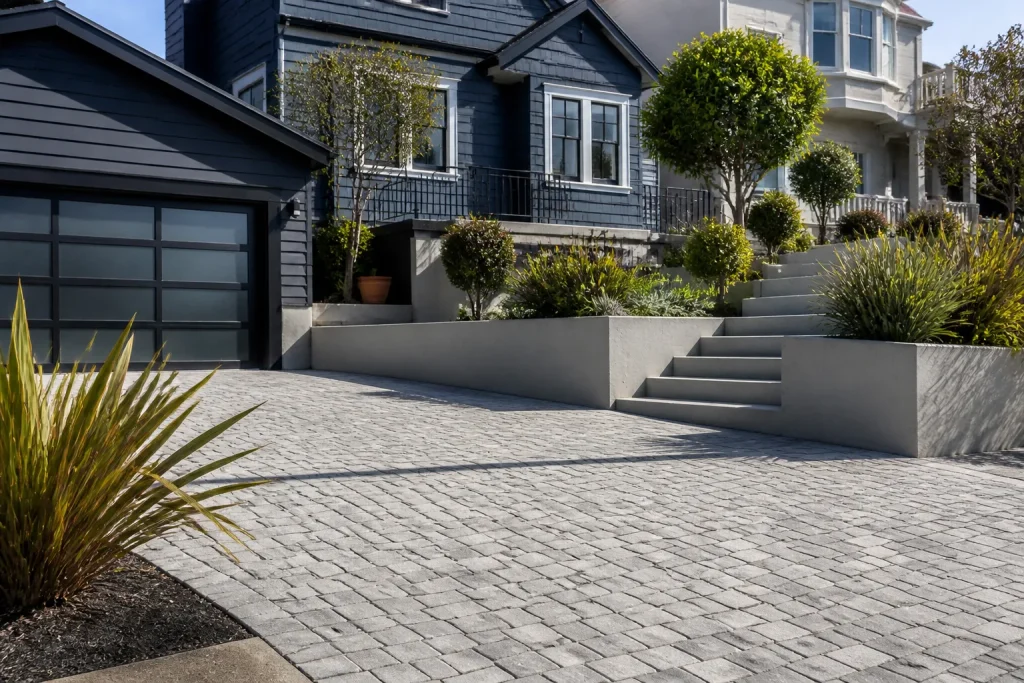
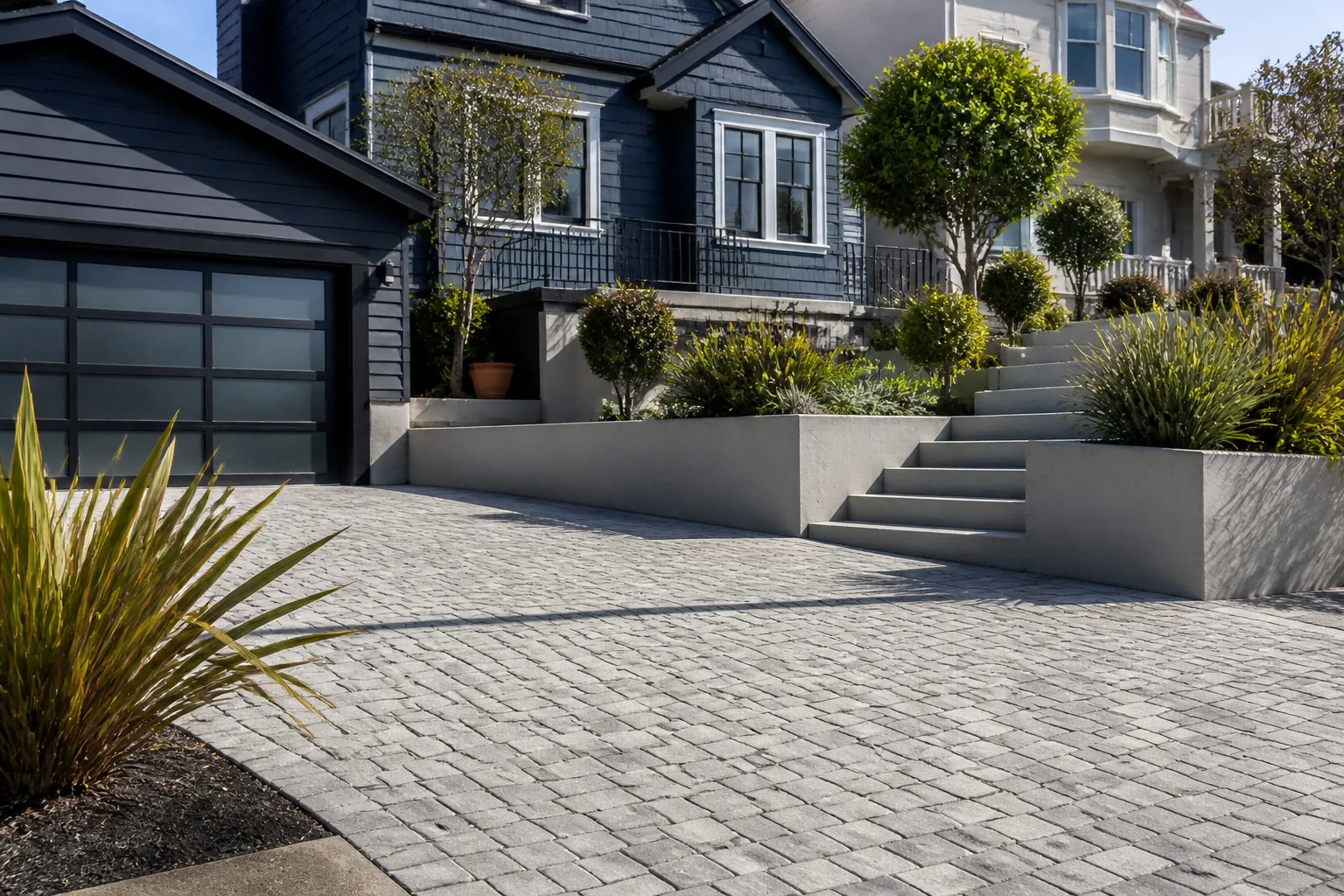
Driveway & Pavers Cost Guide: What San Francisco Homeowners Pay in 2026
The national average for paver installation is $15 – $25 per square foot. In San Francisco, the honest range starts at $28 and can reach $65 before a single paver is laid. That gap isn’t gouging. It’s permits, slope, haul-away, and labor rates that don’t exist in most of the country. This guide breaks out every line that creates the difference, so you can audit any bid you receive instead of guessing whether it’s fair.
If you’d rather not spend a weekend comparing line items, call (844) 797-6388 and we’ll put a written price in front of you before anything starts.
Why San Francisco Paver Costs Run 40 – 60% Above National Averages
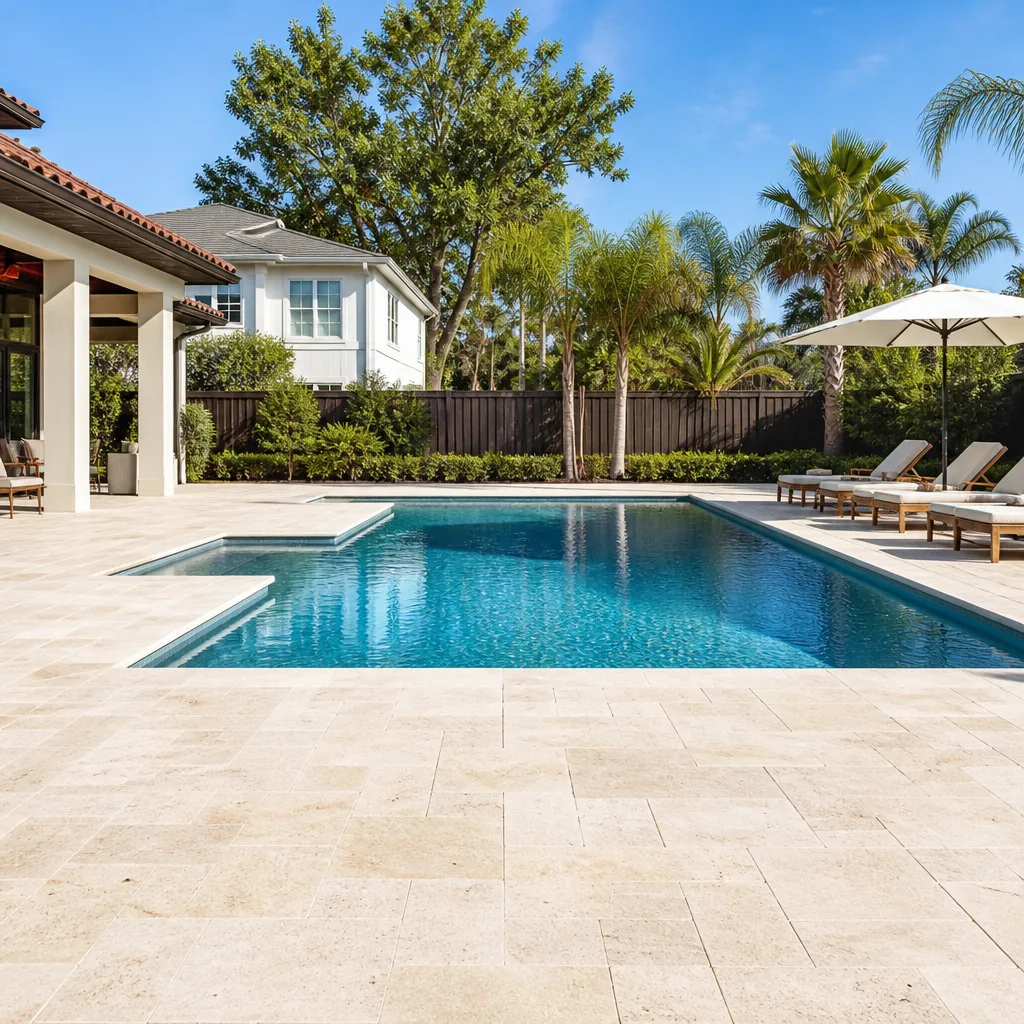
Most cost guides you’ll find quote numbers built for flat lots in low-regulation markets. San Francisco is the opposite of that on nearly every axis. The Department of Building Inspection adds cost before a shovel hits dirt, the terrain adds cost during excavation, and the density of the city adds cost when it’s time to move material out. None of those line items show up in a national average.
Here’s what the four drivers actually look like in 2026:
- DBI permit fees: Curb cuts, driveway widening, and any work touching the public right-of-way require a permit and often a separate encroachment review. Depending on scope, plan a permit allowance of $600 – $2,400. Some interior-lot driveways don’t need one; most do once the apron meets the sidewalk.
- Slope and grade correction: A lot of San Francisco driveways pitch steeper than 12%, which means extra base depth, retaining edges, and drainage. Budget $1,800 – $6,000 depending on how far off grade you are.
- Haul-away under tight access: Excavated soil and old concrete have to leave the property. On a street where a dump truck can’t back in cleanly, that means smaller loads, more trips, and higher disposal fees. We’ve seen haul-away alone run $1,200 – $3,000 on Inner Sunset blocks where the driveway is barely wide enough for a pickup.
- Prevailing wage pressure: Subcontractors working on or near public improvements are subject to prevailing wage rules. That pressure ripples into the whole job even on private work, because crews are choosing between your driveway and a public project that pays more.
Stack those four and you understand why a quote that looks high on a national calculator is actually normal here. The Driveway & Pavers in San Francisco service page walks through the same cost structure in more detail.
Sample Cost Table: 400 Square Foot Driveway in San Francisco, 2026
Here is a realistic breakdown for a 400 sq ft residential driveway, three material tiers, installed in San Francisco. These aren’t lowball numbers. They’re the numbers we actually write on quotes.
| Line Item | Concrete Pavers (Belgard) | Natural Stone (bluestone) | Permeable Grid |
|---|---|---|---|
| Permit allowance | $600 – $1,400 | $600 – $1,400 | $800 – $1,800 |
| Demolition & haul-away | $1,400 – $2,600 | $1,400 – $2,600 | $1,400 – $2,600 |
| Base prep (Class II, 6 – 8″ compacted) | $2,800 – $4,200 | $3,200 – $4,800 | $3,400 – $5,200 |
| Drainage and grade correction | $1,200 – $4,000 | $1,800 – $5,000 | $600 – $2,400 |
| Material (pavers or stone) | $4,400 – $7,200 | $8,000 – $14,000 | $3,200 – $5,600 |
| Install labor | $3,600 – $6,400 | $5,600 – $9,200 | $2,800 – $4,800 |
| Edge restraint & finish | $600 – $1,200 | $800 – $1,600 | $400 – $900 |
| Total installed | $14,600 – $27,000 | $21,400 – $38,600 | $12,600 – $23,300 |
Per square foot, that lands at roughly $36 – $68 for concrete pavers, $53 – $96 for natural stone, and $31 – $58 for permeable grid at this size. Larger jobs spread the fixed costs (permit, mobilization) across more area, so the per-square-foot number drops. A 700 sq ft driveway often comes in $4 – $8 per square foot cheaper per unit than a 400 sq ft one. Small jobs are expensive per foot; that’s true everywhere, and especially here.
Which Line Items Are Fixed and Which Are Negotiable
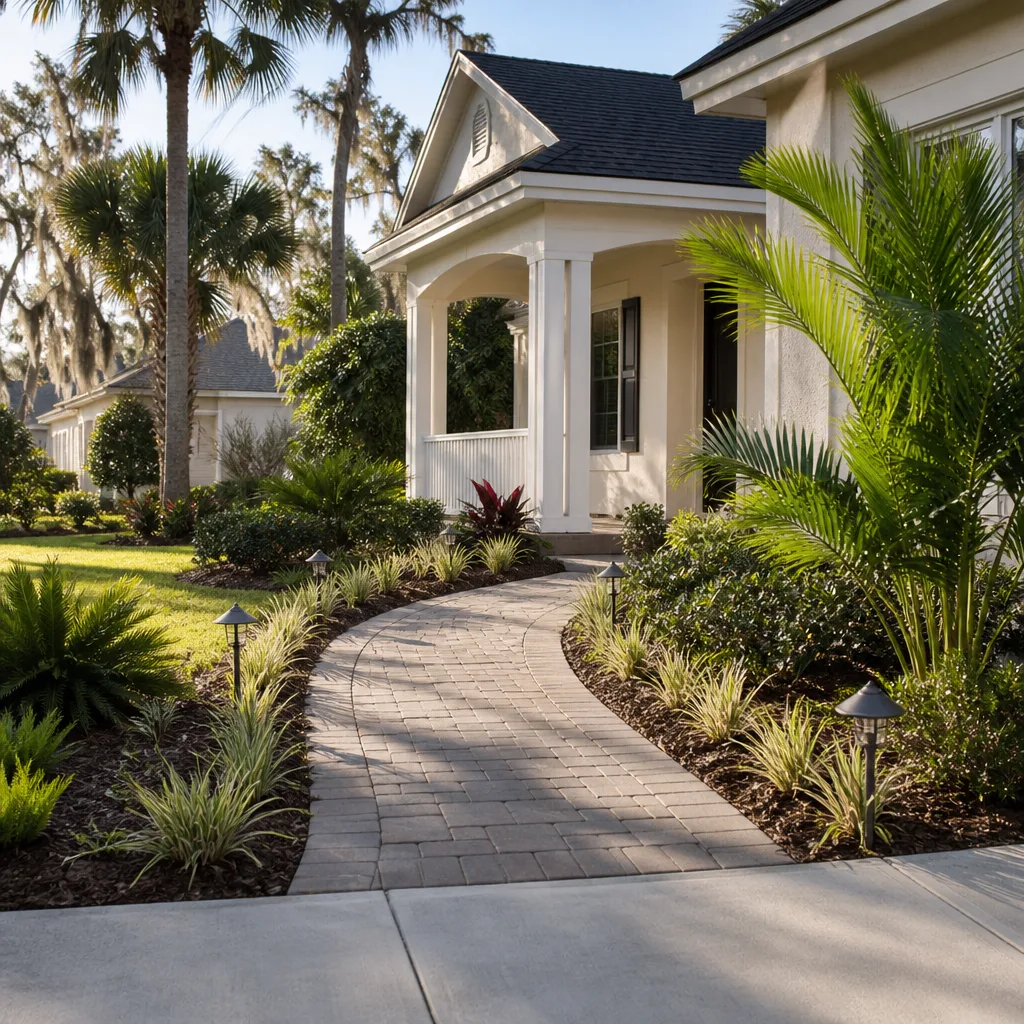
This is where we see homeowners leave money on the table or, worse, get talked into cutting corners that cost them later. Not every line is adjustable, and knowing the difference is the fastest way to spot a bid that’s playing games.
Fixed costs you should not try to shrink:
- Permit allowance. Either it’s on the quote or the contractor is planning to skip it. Skipping it means your driveway isn’t legal, and the next owner’s inspector will find out.
- Base prep depth. San Francisco’s expansive clay soils and the city’s stormwater load mean a minimum 6″ (often 8″) of compacted Class II base. A crew proposing 4″ is quoting a driveway that will crack within three winters. That’s not a bargain, it’s a callback.
- Drainage correction. Water goes where gravity sends it. If the existing grade pitches toward the garage, you either fix it now or repour the garage slab later. We have pulled pavers back up off garage aprons in Noe Valley more than once because the previous install ignored grade.
Negotiable items where you have real choice:
- Material grade. Concrete pavers from Belgard and Techo-Bloc range widely by line. A standard 60mm paver runs meaningfully less than a 70mm tumbled premium than a hand-cut natural stone. Same driveway, three price points.
- Edge treatment. Standard plastic edge restraint is inexpensive. A soldier course or a stone border adds character and roughly $400 – $1,200 depending on length.
- Job size and phasing. If your budget is tight, doing the front 250 sq ft now and the rest next spring lets you keep the permit open and saves mobilization cost on the second phase.
If you want the trade vocabulary explained in one clause: base prep is what goes under the visible surface, edge restraint is what keeps the pavers from spreading, and permeable grid is a system that lets stormwater drain through instead of running off toward your neighbor’s foundation.
How a Signed Change-Order Policy Protects You From 15 – 30% Invoice Creep
Industry data points to a real problem: roughly 1 in 3 paver projects ends up 15 – 30% over the quoted price because the contractor discovers “unforeseen conditions” mid-job and invoices the difference at closeout. In San Francisco, “unforeseen” is often just “we didn’t look.” Slope is visible before mobilization. Subbase depth is testable before quoting. A contractor who walked your driveway and read your grade should already have priced what they’re going to find.
What protects you is simple paperwork. Under Clause 1 of our Haven Standard, the price is written before anyone starts, and no work proceeds on a change until the change order is signed. That means if we open a driveway in the Outer Richmond and discover an abandoned utility line under the subbase, we stop, photograph it, write you the number to route around it, and wait for your signature. You either approve or we leave it in place and work around it. There is no scenario where you find out what it cost after the crew is gone.
We’ve watched this discipline pull a job back from a $6,200 surprise to a $1,400 approved change because the homeowner could see the line item and choose an option. That’s the point. The change order is a control, not a penalty.
For work that touches the fence line at the same time as the driveway, our Fence Installation in San Francisco team can scope both on one plan. And if a paver driveway is part of a bigger yard or ADU plan, the Home Additions & ADU in San Francisco page covers how we sequence site work to keep haul-away costs combined.
What a Red-Flag Bid Looks Like
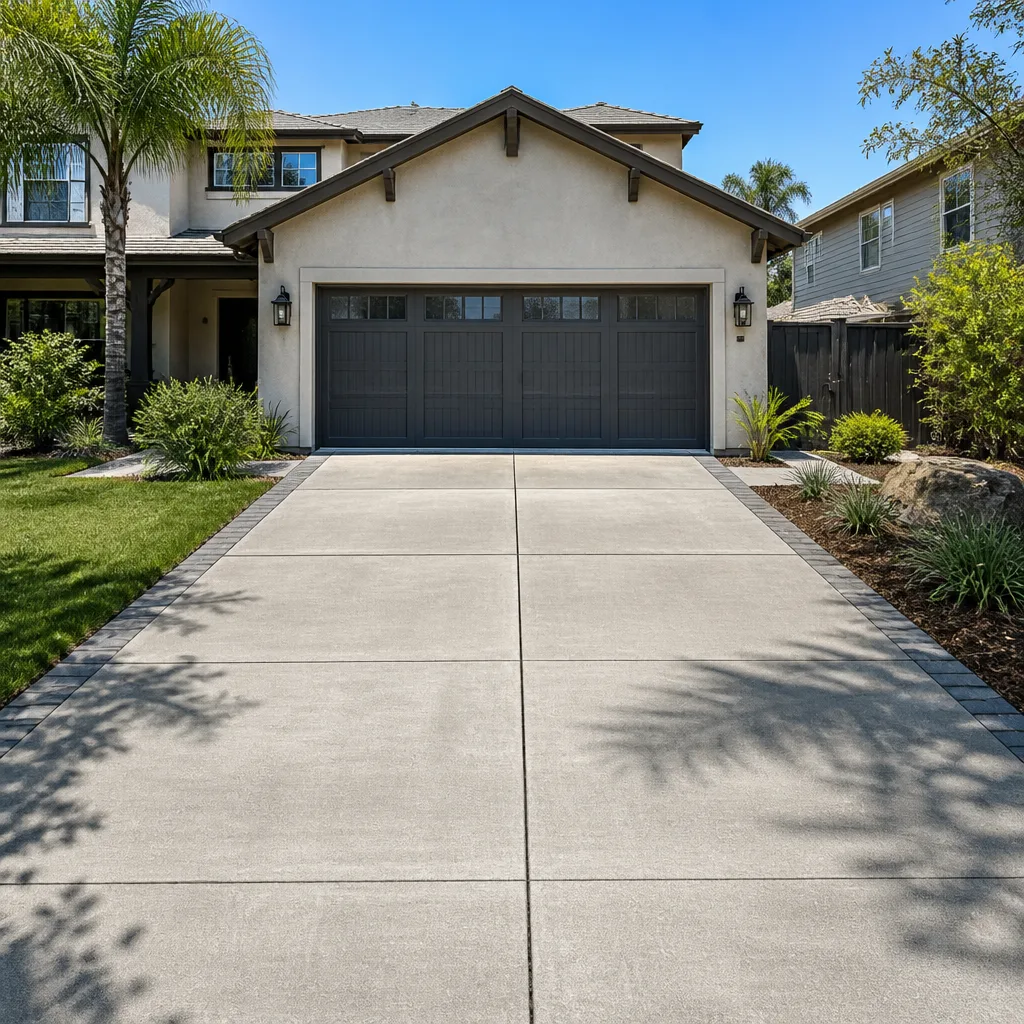
Most homeowners don’t get overcharged because they chose the wrong contractor. They get overcharged because the bid they signed was never complete. Here’s the checklist we’d use if we were the homeowner and not the contractor.
- No permit line item. If permits aren’t on the quote, they aren’t being pulled. In San Francisco, that’s a red flag you can read from the email.
- Lump-sum labor. “Install labor: $9,000” tells you nothing. Ask for labor broken out by phase: demo, base, install, finish. A contractor who can’t break it out doesn’t have a plan.
- Base prep not described. The quote should say how many inches of what class of base, compacted in lifts. If it doesn’t, you’re buying whatever’s cheapest.
- No haul-away. Demo debris has to leave. If there’s no line for it, you’re going to find a dumpster invoice in your inbox in week two.
- No written warranty. The warranty is a document, not a verbal statement. Ours is the 365-Day Done Right Promise: if it isn’t done right, we make it right. Ours is printed on the page.
- No change-order process. Ask explicitly: “How do you handle unforeseen conditions?” If the answer is “we work it out,” walk.
One more tell: no photo record. Every visit here includes a documented photo record as a standard deliverable. Before base goes in, after base goes in, after install. That documentation is what makes a warranty enforceable instead of a nice idea.
When It’s Worth Calling a Pro (and When It Isn’t)
Not every paver job needs a full crew. If you’re refreshing a 60 sq ft walkway between the sidewalk and the stairs, and the grade is flat, you can probably do it yourself with a rented plate compactor and a Saturday. If a bag of polymeric sand is the only material left on your list, call it a DIY job and get on with your weekend.
Where it stops being sensible: anything involving excavation depth, grade correction, drainage routing toward the street, or work within the public right-of-way. At that point you’re dealing with permits, engineering assumptions, and utility locating, and mistakes in that layer aren’t visible for two or three wet seasons. By the time you see the symptom, the diagnosis is expensive. That’s the point where a trained crew pays for itself many times over.
Also worth knowing: if your driveway is part of a larger ADU or addition project, the paver work shouldn’t be bid as a standalone line. Good sequencing saves real money. We cover the trade-packaged approach on our Rowan Construction Group San Francisco home page; the point here is that scoping site work with the building work in one plan rarely costs more and often costs less.
Related services in San Francisco: for full paver scope, see Driveway & Pavers in San Francisco. For the fence line boundary, Fence Installation in San Francisco. For an ADU or addition touching the same lot, Home Additions & ADU in San Francisco.
Our technicians have up to 19 years of experience, and every one of them is background-checked and arrives uniformed. That’s not a selling point on this page so much as context for the number we write. The number was earned.
The Bottom Line
In San Francisco in 2026, a 400 sq ft paver driveway realistically lands somewhere between $14,600 and $27,000 for concrete pavers, more for natural stone, and slightly less for a permeable grid. The gap between that and national averages is almost entirely permit, slope, haul-away, and labor – none of which are negotiable line items if you want a driveway that holds up past three rainy winters. What you can shop is material grade, edge treatment, and job phasing.
The number you should insist on before any work starts is a written one. Flat price, written scope, written warranty, and a signed change order for anything that moves. If a contractor won’t put that in a document, the price on their quote is a guess and you’re writing the check.
If you’re in San Francisco and want a line-item estimate to compare against whatever else is on your kitchen table, Rowan Construction Group San Francisco offers free estimates and a free second opinion on any written estimate you bring us. Call (844) 797-6388. A live person answers, we’ll set a time, and you’ll have a real number in writing before anything gets scheduled.
Frequently Asked Questions
A 400 sq ft paver driveway in San Francisco typically runs $14,600 – $27,000 installed with concrete pavers such as Belgard, $21,400 – $38,600 with natural bluestone, and $12,600 – $23,300 with permeable grid. The range is wide because permit coverage, slope correction, and haul-away conditions vary block by block. Call (844) 797-6388 for an exact quote from a line-item scope, free of charge.
You typically do if the work touches the sidewalk, curb, or public right-of-way, and that’s most driveways in the city. The Department of Building Inspection handles the permit itself, and any work near the curb usually also involves an encroachment review. A complete quote should carry a permit allowance of roughly $600 – $2,400. If a bid has no permit line, ask why before you sign. Call (844) 797-6388 to talk through what your specific driveway will need.
Not without your signature. Under Clause 1 of our Haven Standard, the price is written before any work starts, and no change proceeds until a signed change order is in place. If a crew opens the subbase and finds something the walkthrough missed, work stops, we document it, and you get a written number before we proceed. That’s how the final invoice stays within a few percent of the agreed price. Call (844) 797-6388 to schedule your free estimate.
A 400 sq ft driveway typically takes one to two weeks of on-site work once permits are in hand: two to three days of demo and haul-away, two to three days of base prep and compaction, and three to four days of install and finish. Permit review can add several weeks depending on scope and DBI’s current queue. That timeline assumes reasonable weather; January and February in San Francisco can stretch any outdoor schedule. Call (844) 797-6388 for a schedule estimate on your address.
Written by the team at Rowan Construction Group San Francisco.
Need Construction Help?
Call Rowan Construction Group San Francisco - licensed & insured, here with fast after-hours help in San Francisco.
(844) 797-6388